


About Everest Cement Roofing Sheets
For over 91 years, Everest has been at the forefront of providing roofing solutions in India, installing over one billion square meters of roofing products across the country. With a focus on cement roofing sheets, we cater to the residential, commercial, and industrial sectors, offering a range of asbestos as well as non-asbestos roofing sheets.
At Everest, we understand your unique requirements and strive to meet them with our superior cement sheets that guarantee top-notch quality, reliability, and safety.

#UparWalaSambhalLega
With the beauty and strength of Everest Supercolour sheets, your roof will add to your "shaan" for a long time to come!

#KahaniKhushiyonKi
With water-repellent & anti-fungal properties, Everest Supercolour cement sheets were the perfect fit for protecting Nanasaheb Dhumal’s cows from heat and diseases.
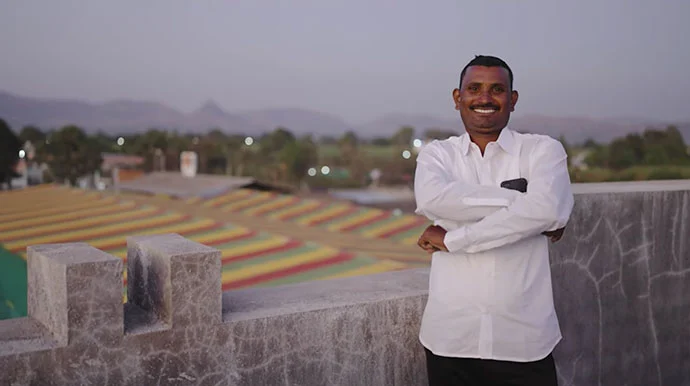
#ApniPehchaan
#ApniPehchan campaign celebrates how Everest Supercolour can help you create a home that truly reflects your identity dedicated to range of eye-catching colours and design options.

Our Roofing Products
Explore our diverse range of cement roofing sheets which provide reliable and durable roofing solutions for your home.


Evercool Roofing Sheet
Unique cool roofing sheet developed with high Solar Reflectance Index (SRI) to keep your interiors cool and comfortable.
Read More

CBS - Fibre Cement Roofing Sheet
Easy to fix, fire-resistant, economical, low noise, low heat, and corrosion-free sheets made with unique fiber mesh technology.
Read More

Supercolour Roofing Sheet
Water-repellent, anti-fungal, and extremely durable coloured cement sheets available in four attractive colors.
Read More

Hi-Tech Roofing Sheet
Non-corroding, fire-resistant, and weather-proof non-asbestos roofing, reinforced with high-impact PVA fibres for extra durability.
Read More

EPDM
Washers
High-quality leakproof washers designed to be very durable and resistant to UV rays, heat, and cracking.
Read MoreOur Roofing Sheet Projects
Our cement roofing sheets have widespread application across industries. From commercial to residential,
we have the ideal roofing solution for every project.
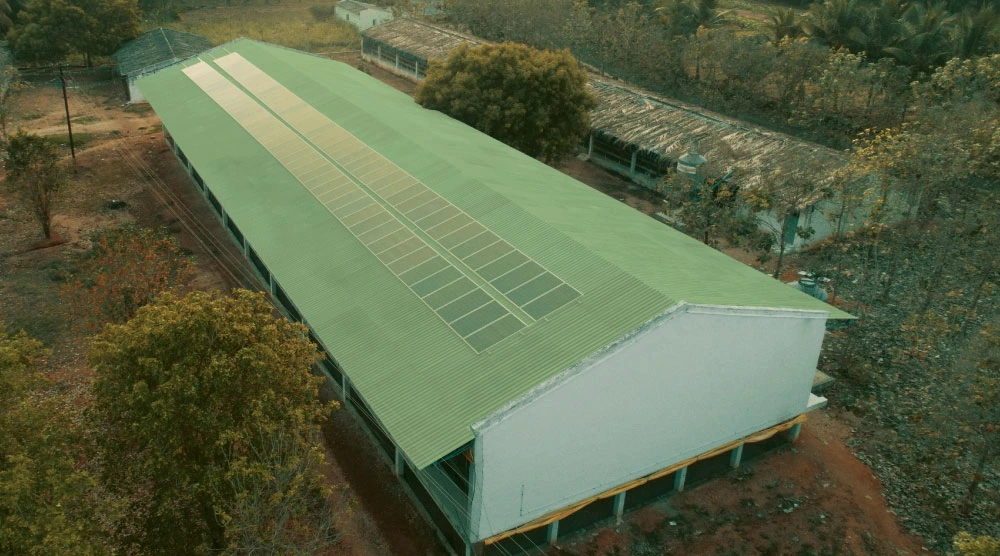
Commercial Poultry Farm, Erode
With over 200,000 chickens residing in a poultry factory, the birds were exposed to various diseases due to fungi, so a roofing solution that avoids water seepage was a must. Everest Supercolour made with imported fiber mesh technology and advanced color technology not only added to the aesthetic beauty but also its superior functionality solved the issues for poultry farm owners.
Why Choose Everest Roofing Sheets?
Pioneers of the Industry
Everest is the pioneering force behind introducing fibre cement roofing sheets in India, with our first manufacturing facility in 1934. Since then, we’ve set a benchmark in the industry by bringing forth roofing solutions that stand the test of time.
91 Years of Excellence
With a proud legacy spanning 91 years, we have established ourselves as a trusted name in the roofing industry. Our long-standing presence reflects our commitment to delivering exceptional quality and unmatched customer satisfaction.
Innovation at the Forefront
Innovation is the driving force behind everything we do. We believe in staying ahead of the curve by embracing the latest advancements in roofing technology, from introducing cutting-edge materials to implementing groundbreaking manufacturing techniques.
Testimonials
“
Even 20 year old Everest CBS sheets are still intact!
Installed Green Supercolour because it is the colour of nature. Also, it keeps my chicken cool

D.Gokul Prasad
Perundurai, Erode, Tamil Nadu“
Supercolour is really super!
Maintains the temperature underneath and does not absorb water. It has been more than a year and it did not blacken.

Santosh Kakad
Sangamner, Maharashtra“
Will only use Everest Supercolour!
Supercolour sheets reduce the temperature by 5 to 6 degrees and no algae formation is there.
Arun Jha
Haripur“
Kahani Khushiyon Ki
We are happy that Everest could bring peace, calm, and happiness to the life of Prakash from Nammakal...
Watch Video

Prakash
Namakkal“
Kahani Khushiyon Ki
Maintaining a farm and animal shades can get rigorous & needs a farmer's complete attention & care...
Watch Video

Nanasaheb Dhumal
AkoleAsk Everest
Find answers to frequently asked questions on Everest roofing sheets.
Are cement sheets good for roofing?
Yes, cement sheets are great for roofing as they are durable, fire-resistant, and able to withstand harsh weather conditions. Everest roofing sheets are reinforced with fibre mesh technology to create Fibre Cement sheets which have added strength.
What are cement roofing sheets used for?
Cement sheets are used as a roofing material to provide protection from elements such as rain, snow, heat, and sunlight. They are designed to be durable, waterproof, and to help insulate buildings.
Which roofing sheets are best for my house?
The best type of roofing sheets for your house depends on factors such as the climate, budget, desired aesthetics, and personal preferences. One popular option is cement roofing sheets, as they are affordable, durable, and weather resistant.
How many types of roofing sheets are there?
There are several types of roofing sheets available in the market, such as:
- Fibre cement roofing sheets
- Metal roofing sheets
- Bitumen roofing sheets
- PVC roofing sheets
How do you calculate roofing sheet area?
To calculate the roofing sheet area, you need to measure the length and width of the roof. Multiply these two measurements to get the area in square feet or square meters, depending on your preferred unit of measurement.
Will the roofing sheets be available in my area?
Yes, Everest roofing sheets are available pan India. Check with your local suppliers or contact us now for store details.
I want a roofing sheet dealership in my area. When and how can I start?
Starting a roofing sheet dealership requires thorough market research, an understanding of local demand, and establishing connections with manufacturers or suppliers. If you would like to sell Everest roofing sheets through your new dealership, fill up our contact us form for more details.
What does Everest Industries Ltd do?
Everest Industries Limited specializes in manufacturing of fibre cement roofing, fibre cement boards and panels, as well as pre-engineered steel buildings. The Company provides integrated solutions tailored for industrial, commercial and residential needs in both urban and rural areas. These products are used for roofing, dry walls, ceilings, while pre-engineered buildings are used to create sheds for warehousing, manufacturing and other allied industries.
EIL is listed on the Bombay Stock Exchange (BSE) and the National Stock Exchange (NSE). It has eight plants and a presence in all 28 states and 8 union territories and serves markets in 18 countries.
Who operated the Kymore plant before Everest Industries Ltd?
Brief Overview:
The plant has been operated by various companies since inception. Specifically:
- Asbestos Cement Ltd: 3 April 1934 to 24 October 1983
- Everest Building Product Ltd: 24 October 1983 to 19 September 1990
- Eternit Everest Ltd: 19 September 1990 to 25 July 2003
- Everest Industries Ltd: 25 July 2003 and ongoing
Detailed history:
Asbestos Cement Ltd. was incorporated in 1934 as a joint venture between Turner & Newall Ltd. (UK) and C.P. Cement Co. Ltd. (which merged in 1936 to form Associated Cement Companies Ltd. – ACC).
Shareholding History & Evolution
- 1934 (Inception): Founded as Asbestos Cement Ltd. with two primary corporate promoters: Turner & Newall Ltd. (UK) and ACC.
- 1950s–1980s (FERA Dilution): Under FERA (Foreign Exchange Regulation Act) rules, foreign promoter stakes were diluted. In the late 1980s, Turner & Newall International, UK sold its entire stake.
- 1988–1989 (Etex Group Entry): Turner & Newall sold its stake to Eteroutremer (Etex Group), Belgium, and the company eventually rebranded to Eternit Everest Ltd. in 1990 (and later Everest Industries Ltd. in 2003).
- 2001–2002 (ACC Takes Control): As the Etex Group scaled down asbestos-related holdings in Europe, ACC acquired the 50% stake held by the Eternit/Etex group in February 2002 through an inter-se promoter transfer, raising ACC's total voting stake in the company to about 76.01%.
- 2003 – 2005 (ACC Takes Full Control): The Company became a 100% subsidiary of ACC under ACC management.
- 2006 (Current Promoters Take Control) – ACC transferred its stake to Everest Finvest Pvt. Ltd. which in turn was transferred thereafter to Falak Investment Pvt. Ltd.
- Promoters Holding: ~50.22% (held by promoter group under Falak Investment Private Limited)
What are the products manufactured at the Kymore plant?
Everest Industries’ Kymore (District Katni, Madhya Pradesh) plant manufactures Fibre-Cement Roofing Sheets & Accessories. At Kymore, a high emphasis is laid on Safety, Health & Environment to ensure a high level of safety at the workplace. Among similar manufacturers in Madhya Pradesh, Everest Industries was the first unit to receive the State Level Award for excellence in the areas of Safety, Health, and Environment.
Our Everest Fibre cement sheets manufactured at Kymore besides other plants have been extensively used for rural housing under the Pradhan Mantri Awas Yojana (PMAY-Rural), animal shelters like gaushalas, poultry sheds etc. for many decades.
How is waste from the company’s current operations managed?
Everest Industries does not dispose asbestos waste. Either asbestos-containing dry waste is reused in the manufacturing process as Hard Ground Waste or re-circulated as Green Asbestos Waste. Defective or discarded products such as boards, panels and sheets are processed into Dry Waste Recycle (DWR) and reintroduced into the manufacturing cycle wherever feasible.
In rare cases if hazardous waste is available, then it is routed exclusively through Pollution Control Board (PCB)-authorised vendors for compliant and secure disposal.
What are the company’s records on employee health, especially asbestos-related cases?
There have been no asbestos-related cases in the last 20 years. Pre-employment medical examinations are conducted, and as per statutory requirements, annual health check-ups are carried out for employees and workmen at the plants. Training modules for employees and workers include asbestos awareness and asbestos safety.
Everest Industries Ltd. has an Occupational Health and Safety Management System certified to ISO 45001:2018 across all its sites and the corporate office. Comprehensive EHS training modules have been developed and deployed covering induction, asbestos safety, rigging and lifting operations, defensive driving, emergency response, and critical risk management.
What raw material does the Kymore plant use today?
Chrysotile fibre is used in the range of 7-9%. Cement, fly ash, pulp and other additives comprise the rest of the raw material mix.
What is chrysotile, and how is it different from other types of asbestos?
Asbestos is a naturally occurring mineral found in rock formations. It falls into two chemically and mineralogically different groups. The first is serpentine, which is chrysotile (white asbestos). The second is amphibole, which includes crocidolite (blue asbestos) and amosite (brown asbestos). Chrysotile is composed mainly of magnesium and silica. Use of the amphibole variety, including blue asbestos, has been prohibited for decades. Numerous scientific and data-based studies across the world and the globe have proved that chrysotile is extremely safe during mining, manufacturing and use of chrysotile fibre cement sheets. Information on the same can be sourced from fcpma.in.
Which type of asbestos is used in fibre cement products in India?
Only the chrysotile variety is used in the manufacture of fibre cement sheets and pipes in India. It is imported, mostly from Russia, Kazakhstan and Brazil.
What is a fibre cement sheet made of?
A fibre cement sheet consists of chrysotile fibres (7 to 9%), cement (about 40%), fly ash (about 30%), and wood pulp and water. The chrysotile fibres act as a reinforcing agent and are bonded within the cement and fly ash matrix.
Why is fibre cement roofing widely used?
Fibre cement sheets have been used in India for over 80 years. They are safe, weather-proof, fire resistant, non-combustible, corrosion resistant, durable and low on maintenance. They are used for warehouses, cattle and poultry farms, dairies, factories and low-cost housing. Apart from India, China, Russia, Brazil, Indonesia, Thailand and Vietnam are among the top users of fibre cement sheets. Their manufacture also uses fly ash, a waste generated by thermal power plants, as a partial replacement for cement.
What standards do fibre cement products follow?
Fibre cement products are manufactured under licence and conform to the following Bureau of Indian Standards specifications:
- IS 459/1992 for corrugated roofing sheets
- IS 2098/1997 for building boards
- IS 2096/1992 for flat sheets
- IS 1626 (Part III)/1994 for roofing accessories
- IS 1592/1989 for AC pressure pipes
In addition to the above, the manufacturing process also complies with the applicable norms and guidelines laid down by the relevant authorities.
Is the manufacture and use of chrysotile fibre cement products permitted in India?
Yes. Chrysotile fibre cement products are manufactured and used legally in India. The Supreme Court of India has declined petitions seeking a ban on asbestos products, in 1995 and again in 2011 since they are safe and not harmful to humans.


